Our last jaunt was in Rome, a city I hold very close to my heart. Rome was founded by Romulus and Remus, two brothers that were born in Tuscany but orphaned and raised by an Etruscan she-wolf, or so the story goes. With so much amazing history, I loved the months I spent on Campo di Fiori and the opportunity to come back is so exciting. The moment we arrived I wanted to go back to the Campo. I figured out where the Trattoria was that we frequented when we were in Rome (with help from some of my classmates) and made a reservation for us. The Trattoria der Pallaro is close to the Campo and it is an ostería. There is no menu, you just get served and eat, and then pay (cash only). I was able to tell them that Michael was a vegetarian which was a success. Lots of locals at this restaurant which is always a good sign.
Campo di Fiori

My old apartment, 2nd floor with the shutters open

They first brought us plates of prosciutto, mozzarella, tomatoes, lentils, and suppli (breaded rice balls) with the house wine of course. Then came the second course of pasta, both carbonara and pomodoro (tomato sauce). The meat was pork, which came with spinach, and then some strawberry liquor and a lemon custard cake for dessert. At the end of the meal I asked if they could send Paola out and she came by our table. Such a lovely woman, exactly what you would expect of an Italian grandmother. I told her in Italian that this was our favorite restaurant 15 years ago, when I was studying here. She sounded like she actually understood me, too! After paying our ridiculously low price of €25 for all that food, we headed out.


After dinner my mom and I walked around Campo di Fiori and via Giubbonari, the shopping street that leads to the Campo. There were a lot more restaurants than shops, although this was at night, but there were also more tourists and I heard a lot more English. There was a hookah bar and a cannabis shop as well, which we never would have seen in 2003. On the walk back to the hotel we also stopped at the Campidoglio, which is stunning at night, and my favorite perch to view the Roman Forum.
Campidoglio by night

The next morning we headed to Vatican City, the independent City State with about 600 citizens and its own king (the Pope). We had a tour of the galleries that was super interesting so I’ll share some fun facts with you...
The Sistene Chapel was built in the 1400s but Michaelangelo was commissioned to paint the ceiling and the last judgement wall in the 1500s. He was commissioned by Pope Julius but it was controversial because Michaelangelo was a sculptor, not a painter, and all of his figures were very large, naked, and muscle-y. He had 5 years to paint the ceiling of the chapel, and you can tell the side closer to the last judgement wall was more rushed because the figures were fewer and larger. The infamous painting of Adam and Gods hands touching was the first time God was ever painted with a human face.
So Michaelangelo finished the ceiling and then was invited back to paint the last judgement wall. There was a bishop who told Michaelangelo that his work was good not for a chapel, but for a restaurant. So Michaelangelo painted this bishop in hell with a serpent grabbing onto his genitals. The bishop was upset and told the pope to make Michaelangelo change it, but the painters response was, when you fix the church, I’ll fix the painting.
Michaelangelo was the first painter to be recognized as a genius painter by name, and thus, no other painter was allowed to have his name. So when Caravaggio hit the scene he had to change his name.

The other interesting artist we learned about as Raffaello, who was much more charismatic and social than Michaelangelo was. Raffaello painted the papal apartment using vibrant colors, that were his trademark. His pupils did. It have his color recipes so it was hard for them to carry out his work when he died at age 37. Raffaello has this famous painting called School of Athens that depicts all famous artists of the time on the bodies of Greek philosophers. Because Michaelangelo was so private and had locked himself in the Sistene chapel while he was painting, Raffaello didn’t put him in his painting. But once he saw the finished Sistene chapel, he realized what a genius Michaelangelo was and went back to his painting at night to add Michaelangelo to it. So he is shown in the foreground, looking down and in darkness. The painting looks better and more balanced without him, but this is why.

The paintings Raffaello paints after this point have more large naked muscley bodies as he is emulating Michaelangelo, who lived until age 89.
Before we got into the Sistene chapel, we walked through halls with amazing Roman art, tapestries, and maps. All of the maps were shown not with north up, but from the vantage point of the Vatican. So anything south of the Vatican was shown upside down. Also the statues that were shown naked all had fig leaves added to them as it was offensive to the church.
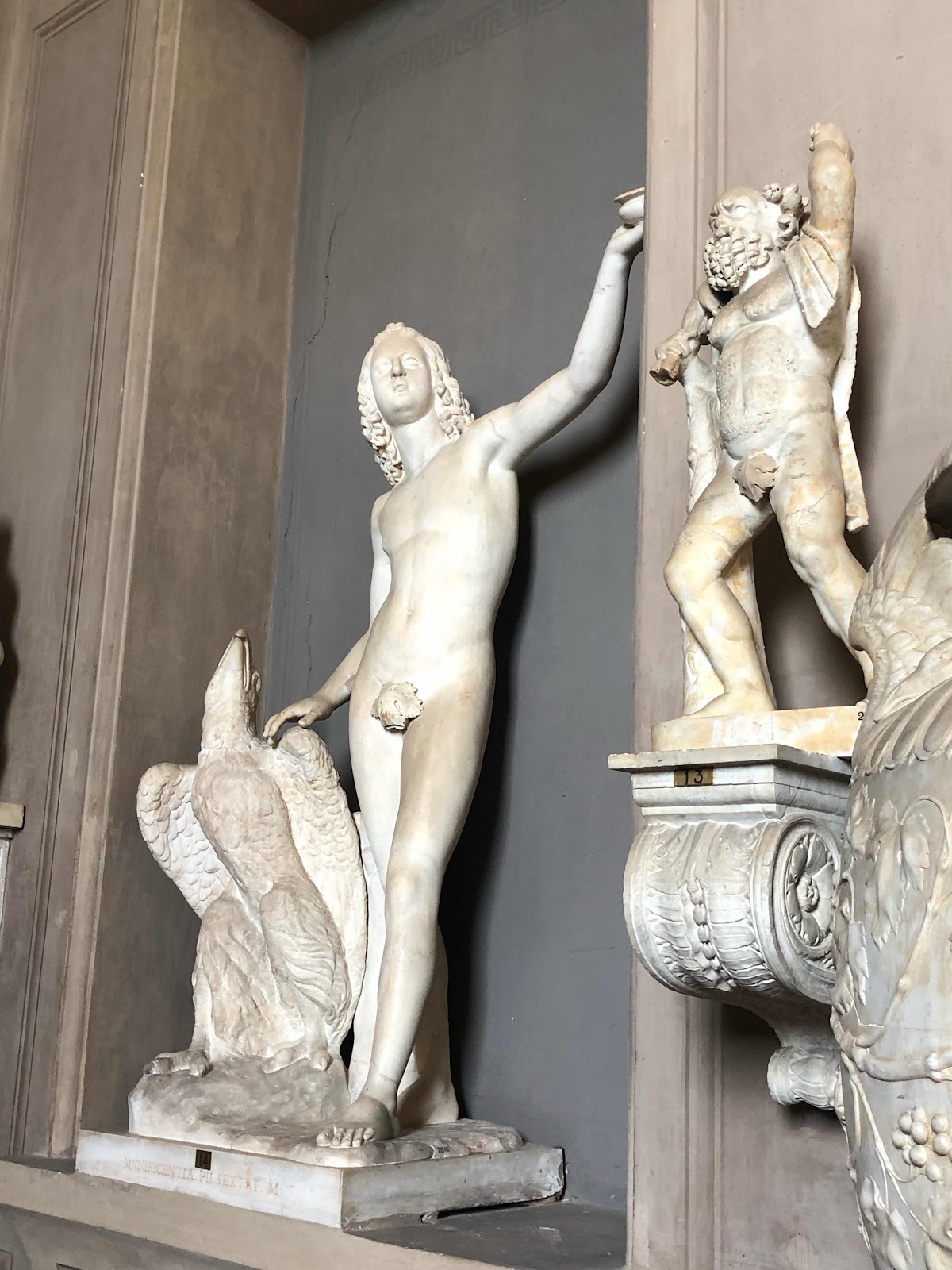
We also went through the old and new papal apartments, and a gallery of modern art, gifts to the popes over the years. The original apartment was abandoned because no one wanted to live there after Pope Borgia. During this time, the Pope was not supposed to have any family or children but all of them did it. Except they would lie about it and say something like, “oh that is my nephew”. But they would make great campaign to get these children to become the next pope. Borgia decided not to lie about any of it. He just admitted that his kids were his kids. For this honesty, future popes refuses to live in the apartment of sin and created a new apartment.
Old papal apartment


From the Sistene chapel we went to St. Peter’s Basilica, so large that the Statue of Liberty can fit inside the dome. It’s truly impressive. The marble panels throughout the Vatican are all taken from the ancient Roman monuments throughout the city and repurposed here. So the marble from the forum and the colosseum that is missing, is all here.
Outside the church getting ready for the Pentecost mass


After the Vatican tour we headed to lunch at Giggetto. My mom and I split the porcini mushroom fettuccini and the prosciutto e melone, and it was spectacular. Michael got artichoke pasta and angel and Nicole split some amazing eggplant parmigiana. The eggplant parm here is very different than we are used to. It’s still breaded but not as much layered. The skin is also still on the eggplant.

From here we went to the Pantheon for a quick visit but it was super hot and we didn’t have much time before the Colosseum and Roman Forum tickets. I will say we didn’t have too great of a time here because we didn’t have a guide for me to write down fun facts and I don’t remember a lot of what I learned the other times I was here. But it was fun to walk around Ancient Rome. It happened to be pride weekend also here so that was kind of a cool juxtaposition seeing a pride parade going through the area.


For dinner last night we went to Sara Margherita, a hole in the wall local spot recommended by my friend Morgan. The house wine flowed freely, the artichoke appetizers were delicious, the meatballs were amazing, and the pasta was all homemade and perfect. Again I split with my mother, meat ravioli and linguine con cacio, pepe, e ricotta (cheese and pepper). Both were amazing. It was spectacular and a great way for the group to end the trip.


And that’s the end! It was a fabulous trip and I was so happy to share it with so many of my favorite people. It was definitely an adventure to remember. And filled with love! Grazie miele!